Manufacturing has been here before.
Every generation brings a new wave of automation, a new round of headlines about the death of the factory job, and a new reality that lands somewhere more complicated than the predictions suggested. The power loom. The assembly line. The industrial robot. Each time, the work changed. Each time, people adapted – eventually.
This time feels different in scale. And in speed.
The Old Model
For decades, manufacturing ran on a clear division of labour. Skilled tradespeople carried knowledge built through years of hands-on experience. Semi-skilled operators managed repetitive processes. A supervisory layer oversaw quality and output.
The work was physical, hierarchical, and largely analogue. You learned on the job, from people who’d learned the same way before you. Institutional knowledge lived in people, not systems.
According to the US Bureau of Labor Statistics, automation has already eliminated 1.7 million routine manufacturing positions since 2000. But the current shift is qualitative, not just quantitative. It isn’t only removing jobs – it’s changing what the remaining jobs actually require.
What AI Is Actually Doing to the Floor
The factory of 2025 looks materially different from a decade ago.
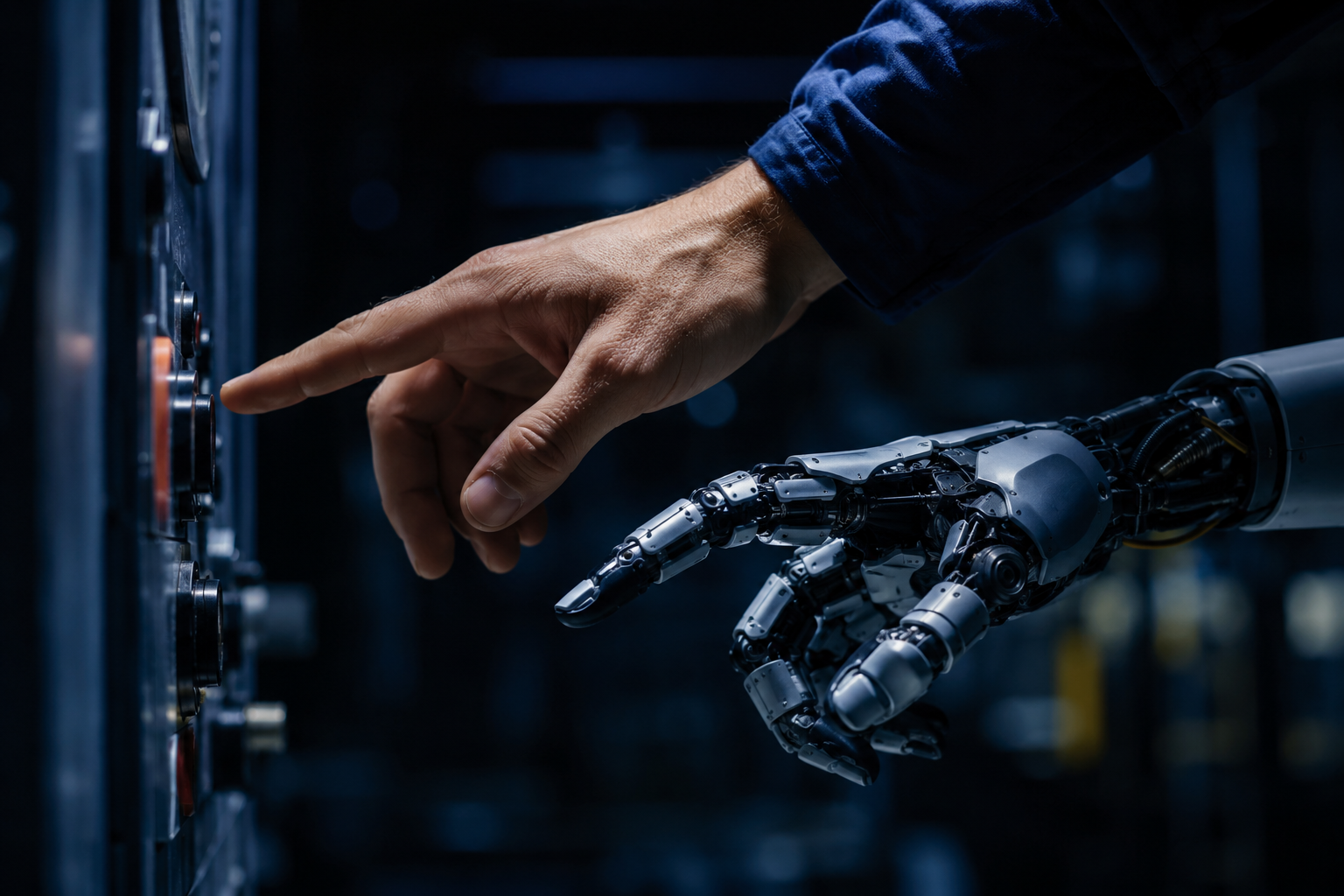
Collaborative robots – cobots – now work directly alongside human workers rather than replacing them entirely, handling precision tasks while humans manage oversight, exceptions, and judgment calls. Factory operators are increasingly becoming data technicians, managing interconnected systems instead of single machines. Maintenance teams interpret sensor-driven insights rather than waiting for something to break. Quality control is shifting from human inspection to AI-powered computer vision detecting defects mid-process.
Digital twin technology – virtual replicas of physical production environments – allows manufacturers to simulate process changes before implementing them, cutting deployment times and reducing costly errors. BMW and Tesla are among the manufacturers already running production environments where AI-powered systems analyse data streams in real time, flagging inefficiencies and adjusting operations without waiting for human intervention.
The physical and digital have merged on the factory floor. The workforce hasn’t fully caught up.
The Skills Gap Problem
This is where the numbers get uncomfortable.
A 2024 Deloitte and Manufacturing Skills Institute report projects the sector faces up to 1.9 million unfilled roles by 2033. Not because the work is disappearing – because the skills required have shifted faster than the talent pipeline has been able to respond. A growing number of experienced workers are retiring, fewer young people are entering the sector, and the technical demands of Industry 4.0 are creating a widening capability gap.
The entry-level problem here is distinct from the rest of this series. In dev, finance, and legal, AI is absorbing junior work and compressing the training pathway. In manufacturing, the challenge runs in both directions; according to the US Census Bureau’s Quarterly Survey of Plant Capacity, a third of engineering roles go unfilled each year, while automation is simultaneously removing the lower-skilled entry points that once brought people into the industry in the first place.
You can’t build the workforce you need if you’ve removed the rungs people used to climb.
Where Manufacturing Is Actually Growing
The roles emerging above the automation layer are genuinely interesting.
Cobot operators and robotics technicians – workers who understand calibration, safety protocols, and workflow integration for human-robot collaboration. The global cobot market, valued at $1 billion in 2024, is projected to reach $2.2 billion by 2031 according to the International Federation of Robotics – demand is growing faster than training programmes can produce the people to meet it.
Predictive maintenance specialists – technicians interpreting AI-driven sensor data to prevent equipment failure before it happens, moving maintenance from reactive to analytical.
Digital twin engineers – specialists who build, manage, and interrogate virtual production models. A role that barely existed five years ago and is now listed across major manufacturers globally.
AI quality assurance technicians – overseeing computer vision systems, validating outputs, and managing the exceptions automated inspection misses.
What is emerging is a new kind of specialist; the digital tradesperson, blending hands-on skill with digital capability and progressing through a clearer career path than traditional apprenticeships offered.

The TYP View
Manufacturing’s workforce challenge is a verification problem in both directions.
Employers need candidates who actually have the hybrid skills the modern factory floor demands – not just traditional trade qualifications that no longer reflect the full picture. Candidates need roles that honestly reflect the technology environment they’re walking into, not job descriptions written for a factory that no longer exists.
The gap between what gets advertised and what the role actually requires has always been a problem in recruitment. In manufacturing right now, it’s becoming critical.
Real People. Real Roles. Verified.